
Trigger Points: Understanding, Locating, and Treating Them in Massage Therapy
What Are Trigger Points?
Trigger points are hyperirritable spots found in skeletal muscle and its fascia. They are small, localized areas where muscle fibers are contracted and unable to fully relax, forming a tight “knot” or nodule. When palpated, a trigger point is often tender and may refer pain to other predictable regions of the body. This is a defining characteristic: trigger points often cause pain elsewhere, not only where they are located.
Trigger points can develop due to:
- Poor posture or repetitive strain
- Muscle overuse or overload
- Physical or emotional stress
- Inactivity and poor circulation
- Direct trauma to muscle tissue
They are commonly associated with myofascial pain syndrome, though nearly anyone may experience them at some point.
Characteristics of a Trigger Point
A trigger point typically presents with:
- A palpable, taut band within the muscle
- A hypersensitive tender nodule
- Referred pain when pressure is applied
- Local twitch response (a brief contraction when stimulated)
- Reduced range of motion and muscle weakness without atrophy
Where Are Trigger Points Found?
Trigger points can occur in any skeletal muscle, but they frequently appear in muscles that maintain posture or perform repetitive work. Some of the most common locations include:
| Muscle | Common Clinical Trigger Point Pain Referrals |
| Upper Trapezius | Up the neck, into the jaw or behind the eye (tension headaches) |
| Levator Scapulae | Neck pain when turning or tilting the head |
| Gluteus Medius / Minimus | Referred pain down the leg (often mistaken for sciatica) |
| Piriformis | Deep gluteal pain, possible nerve involvement |
| Quadratus Lumborum | Low back pain and hip discomfort |
| Masseter and Temporalis | Jaw tightness, headaches, bruxism |
Trigger points may also be found near muscle attachments, especially where muscles endure repeated tension or stress.
How to Locate Trigger Points
Massage therapists locate trigger points through palpation and client feedback.
Techniques to identify:
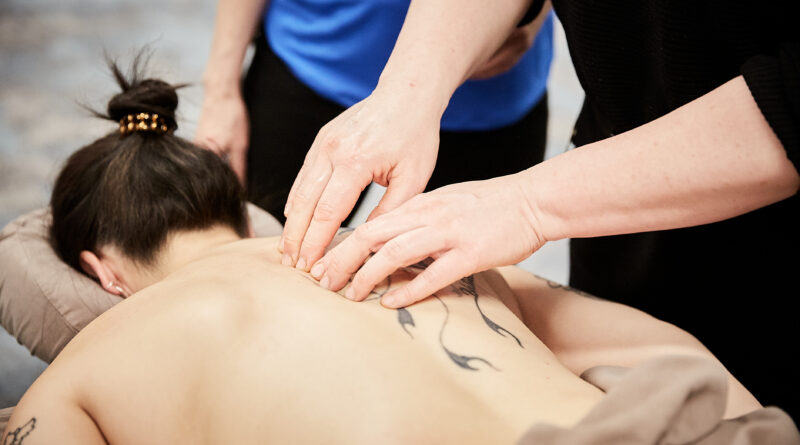
- Flat Palpation
Pressing fingers across the muscle fibers to feel for taut bands. - Pincer Palpation
Grasping the muscle between fingers and thumb (useful on trapezius, SCM, etc.). - Ask the Client
“Does this reproduce your familiar pain?” — referred pain confirmation is key.
How to Treat Trigger Points During Massage
Successful trigger point therapy relies on controlled, sustained pressure to encourage tissue release and improved circulation.
General Treatment Protocol
- Warm the Tissue
- Begin with light to moderate effleurage, petrissage, or heat application.
- Warming increases tissue pliability and reduces discomfort.
2. Apply Focused Pressure
- Use thumb, knuckle, elbow, or tool to apply slow, steady pressure.
- Pressure should reach a level of “therapeutic discomfort” but not sharp or sudden pain.
- Hold for 20–90 seconds, depending on the client’s tolerance and the tissue’s response.
3. Wait for the Release
- Signs include softening of the tissue, decreased pain, or longer exhalation in the client.
4. Stretch the Muscle
- After release, gently lengthen the affected muscle to restore function and movement.
5. Re-Educate and Integrate
- Encourage client to change contributing patterns: posture, breath, ergonomics, or strengthening weak antagonists.
Client Communication
Explain what you are doing and why. Trigger point work can be intense, but it should always stay within consented comfort levels.
A helpful cue:
“Tell me when pressure reaches a 6 or 7 out of 10. It should feel like a deep release, not sharp pain.”
When Not to Treat Trigger Points
Avoid trigger point pressure when:
- There is acute inflammation
- Active infection or fever is present
- The client has compromised sensation in the area
- The muscle is bruised or recently injured
Always work within your scope of practice and refer when symptoms do not resolve or point to systemic causes.
Conclusion
Trigger points are a common source of musculoskeletal pain and dysfunction. By accurately locating and treating them with focused pressure, stretching, and client education, massage therapists can significantly reduce pain, restore motion, and improve muscle function. Effective trigger point therapy requires patience, precision, and communication — and can be one of the most impactful tools in clinical massage practice.
- Article by IMA Founder and CEO Jeppe Tengbjerg

Did you like the article? Or did you like taking part of the World Championship in Massage or one of our classes, then please feel free to give us a nice review on Google.

At the International Massage Association we are ongoing try to elevate the Massage Profession via our many Articles, Podcasts, Masterclasses and via the Educational Conference at the World Championship in Massage
Please follow the IMA Social Medias and read more articles and watch amazing videos: Facebook, Instagram, Youtube, TikTok, Telegram Channel, Whatsapp Channel, Threads, X, Linkedin