The Man Who Changed the Way the World Thinks About Massage and Movement
“Some people invent techniques. Others change the course of history. Per Henrik Ling belongs to the second group.” Article by IMA Founder Jeppe Tengbjerg
Introduction
In the history of massage and manual therapy, few names are mentioned as often as Per Henrik Ling (1776–1839). He is frequently described as the father of Swedish Gymnastics and, in many publications, as the founder of Swedish Massage.
Yet history is rarely as simple as a single sentence.
Ling did not invent massage. Manual therapy had existed for thousands of years before he was born. What he did create was something far more ambitious: a systematic philosophy of movement, health and education that would influence physical education, rehabilitation, physiotherapy and massage for generations.
To understand his achievement, we must first understand the world into which he was born.
Sweden at a Time of Change
The late eighteenth century was a period of enormous transformation across Europe.
The ideals of the Enlightenment encouraged observation, science and education. Medicine was gradually moving away from ancient traditions and towards anatomical research and clinical observation.
Sweden, however, faced its own challenges.
The country had lost much of its former position as a European power. The loss of Finland to Russia in 1809 was a profound political and national shock. Questions about military readiness, public health and education became increasingly important.
Many believed that rebuilding the nation required more than political reform.
It required stronger, healthier and better educated citizens.
It was in this climate that Per Henrik Ling began developing ideas that would eventually reshape physical education.
A Young Man Searching for Answers
Per Henrik Ling was born on 15 November 1776 in the province of Småland, Sweden.
Unlike many physicians of his time, Ling did not begin his career in medicine.
He studied literature, languages and theology. He was deeply interested in philosophy and poetry, and he travelled extensively during his younger years.
One of the experiences that appears to have influenced him most was his study of fencing.
Fencing demanded precision, balance, coordination and control. It required an understanding of how the human body generated efficient movement.
Ling became fascinated by the relationship between movement and health.
Later accounts suggest that he also experienced physical problems himself and believed that carefully prescribed exercise helped relieve them. While this story is widely repeated, historians debate exactly how much of it can be confirmed through contemporary evidence. It remains an interesting part of the traditional narrative, but should be treated with caution.
Historical Note
One of the strengths of historical research is recognising the difference between documented facts and later traditions.
Many biographies describe Ling curing his own rheumatism through fencing exercises. However, the original evidence is limited, and modern historians generally regard the story as plausible rather than conclusively documented.
This distinction matters because history becomes stronger when it clearly separates evidence from legend.
A New Vision of the Human Body
During the early nineteenth century, exercise was often associated with military drills, sport or physical labour.
Ling imagined something different.
He believed that movement could be organised into a scientific and educational system.
The body, in his view, was not simply something to strengthen.
It was something to understand.
His philosophy combined several ideas that were unusual for the time:
- Movement should have a purpose.
- Exercises should be based on knowledge of anatomy.
- Physical training should improve health, not merely strength.
- Education should prepare practitioners to observe and analyse the body rather than simply copy routines.
These principles seem familiar today.
In the early 1800s, they were remarkably innovative.
The Birth of a National Institution
Ling’s growing reputation eventually led to one of the most significant events in the history of physical education.
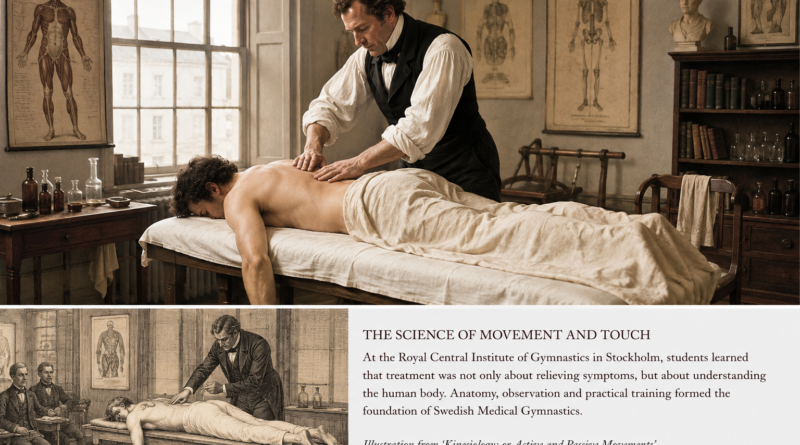
In 1813, the Swedish government established the Royal Central Institute of Gymnastics (Gymnastiska Centralinstitutet) in Stockholm, with Ling playing the leading role in shaping its direction.
The institute became far more than a school.
It trained teachers.
It educated military instructors.
It attracted physicians.
It welcomed visitors from other countries.
Over time, graduates carried Swedish Gymnastics throughout Europe and eventually to North America and beyond.
This institution became the engine through which Ling’s ideas reached the world.
More Than Exercise
One reason Ling’s influence endured was that he never saw movement as an isolated activity.
His system included several branches, often described as:
- Educational Gymnastics
- Military Gymnastics
- Medical Gymnastics
- Aesthetic Gymnastics
Each served a different purpose, yet all were connected by the same belief:
The human body could be trained through knowledge rather than tradition alone.
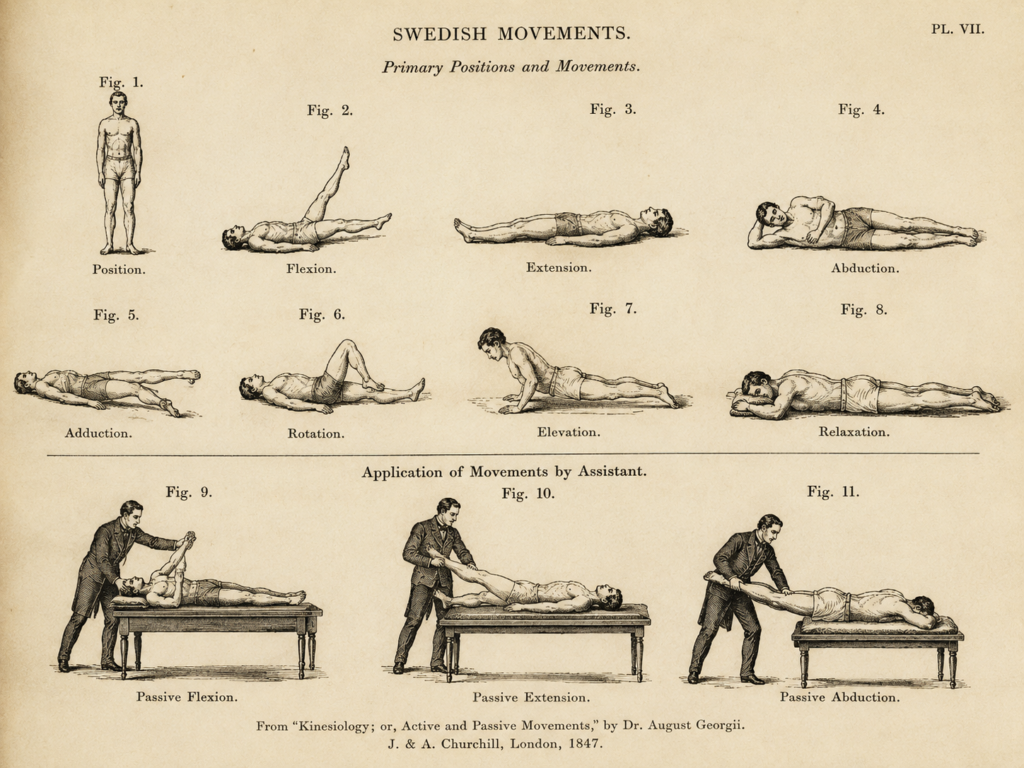
Medical Gymnastics would become especially influential, laying important foundations for later developments in rehabilitation and manual therapy.
A Legacy Often Misunderstood
Today, Ling is frequently introduced as the inventor of Swedish Massage.
This description is understandable—but incomplete.
Massage had existed in many cultures for thousands of years before Ling.
His real achievement was different.
He helped create a systematic framework in which movement, anatomy, observation and manual treatment worked together.
Rather than inventing massage, he transformed the way practitioners thought about the relationship between movement and health.
Understanding this distinction allows us to appreciate Ling for what he truly accomplished.
His contribution was not a single technique.
It was a new way of thinking.
Why Ling Still Matters
More than two centuries later, traces of Ling’s philosophy remain visible in many professions.
Physiotherapists assess movement before planning rehabilitation.
Massage therapists study anatomy and biomechanics.
Sports therapists prescribe corrective exercises.
Rehabilitation specialists focus on restoring function rather than simply treating symptoms.
Modern science has refined and, in some cases, corrected nineteenth-century theories.
Yet the central idea—that movement can be understood, analysed and used therapeutically—remains fundamental.
That is why Per Henrik Ling continues to occupy a unique place in the history of manual therapy.
Key Takeaways
- Per Henrik Ling (1776–1839) founded the Swedish system of Gymnastics.
- He did not invent massage, but he helped place manual treatment within a structured therapeutic philosophy.
- His work united anatomy, movement and education in a way that influenced future healthcare professions.
- The Royal Central Institute of Gymnastics became the centre from which Swedish methods spread internationally.
- Ling’s greatest legacy was not a massage technique—it was a new way of understanding the human body.
Selected References
- Ling, P. H. Gymnastikens Allmänna Grunder.
- Georgii, A. Kinesiology: or Active and Passive Movements (1847).
- Ottosson, A. The First Historical Movements of Kinesiology.
- Ljunggren, J. Historical studies on Swedish Gymnastics.
- Swedish National Archives (Riksarkivet).
- Records of the Royal Central Institute of Gymnastics, Stockholm.
Did you like the article? Or did you like taking part of the World Championship in Massage or one of our classes, then please feel free to give us a nice review on Google.
Please follow the IMA Social Medias and find ongoing Inspiration: Facebook, Instagram, Youtube, TikTok, Telegram Channel, Whatsapp Channel, Threads, X, Linkedin
At the International Massage Association we are ongoing try to elevate the Massage Profession via our many Articles, Podcasts, Masterclasses and via the Educational Conference at the World Championship in Massage.