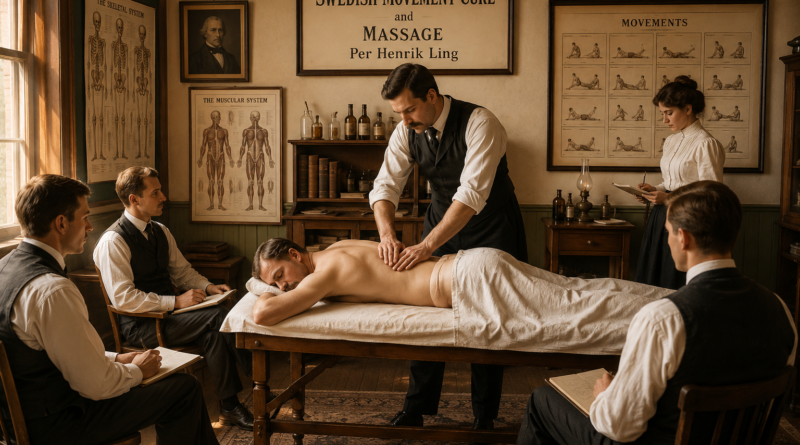
What Did Per Henrik Ling Actually Create? (the man behind Swedish Massage)
“History often remembers names. It is far less successful at remembering ideas.”
- Article by IMA Founder Jeppe Tengbjerg
“Many people believe Per Henrik Ling invented Swedish Massage. However, his own writings focus primarily on movement, education and Medical Gymnastics. The internationally recognised massage terminology used today (such as effleurage and pétrissage) first became widespread decades later”.
Introduction
Ask almost anyone in the massage profession about Per Henrik Ling, and the answer is usually immediate:
“He invented Swedish Massage.”
It is a statement repeated in countless textbooks, training manuals and websites.
But when historians return to Ling’s own writings, a different picture begins to emerge.
Ling himself rarely spoke about massage as a separate discipline.
Instead, he devoted his life’s work to something much broader.
He called it The Swedish Movement—or more accurately, a complete system of Gymnastics.
To understand Ling’s legacy, we must first understand what the word gymnastics meant in the early nineteenth century.
A Different Meaning of Gymnastics
Today, the word gymnastics often brings to mind Olympic athletes performing spectacular routines on rings, parallel bars or balance beams.
That was not Ling’s vision.
For him, gymnastics meant the systematic study and application of human movement.
Movement was not entertainment.
Movement was education.
Movement was medicine.
Movement was prevention.
Movement was national health.
This broader understanding explains why Ling’s ideas attracted physicians, teachers, military officers and politicians alike.
The Human Body as a Living System
One of Ling’s greatest innovations was his insistence that the body should never be viewed as a collection of isolated muscles.
Instead, it should be understood as a connected system.
Every movement involved cooperation between:
- muscles
- joints
- breathing
- posture
- balance
- coordination
This may sound obvious today.
In the early nineteenth century, it represented a remarkably modern way of thinking.
Rather than asking,
“Which muscle hurts?”
Ling encouraged practitioners to ask,
“How does the entire body move?”
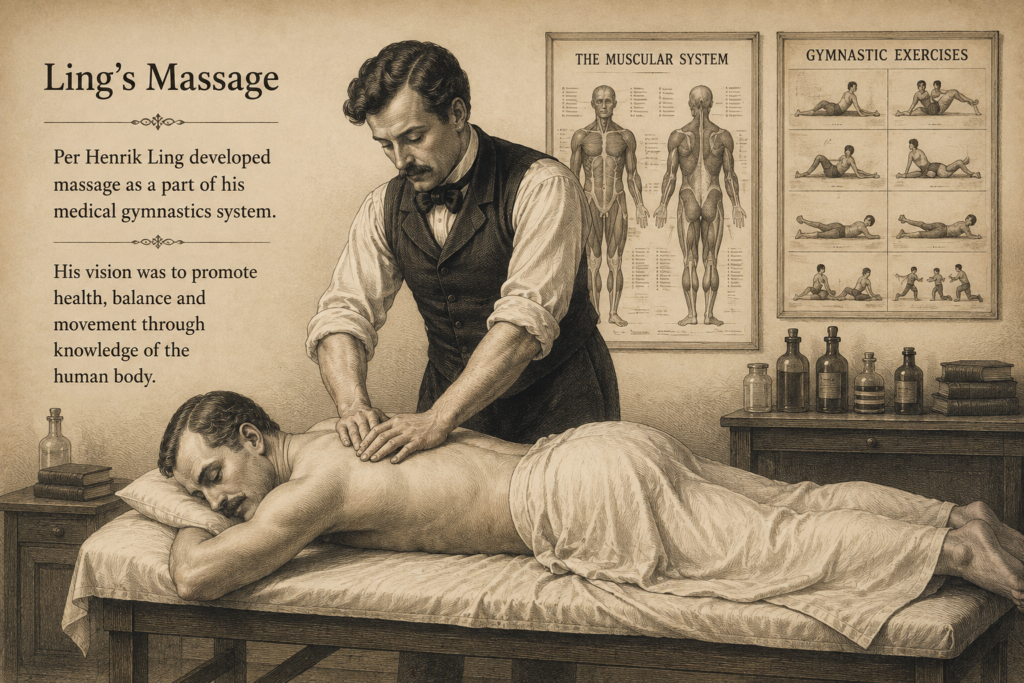
Four Branches of Swedish Gymnastics
Ling organised his work into four distinct areas.
Although historians sometimes describe these categories slightly differently, the overall structure is well documented.
Educational Gymnastics
Designed to promote healthy physical development in children and adults.
Its purpose was not competition, but lifelong physical wellbeing.
Military Gymnastics
Created to improve strength, endurance, discipline and readiness among soldiers.
Following years of political instability in Sweden, this area received considerable government support.
Medical Gymnastics
Perhaps the branch that interests modern massage therapists the most.
Here, movement became treatment.
Exercises were adapted to individual needs, and manual techniques could be used alongside movement to improve function.
This was not massage as an isolated therapy.
It was movement-based rehabilitation.
Aesthetic Gymnastics
The least discussed branch today.
Ling believed that movement should also cultivate grace, harmony and beauty.
Influenced by dance, posture and artistic expression, this area reflected his belief that physical education should develop the whole person—not merely physical strength.
Observation Before Treatment
Perhaps Ling’s most enduring lesson was surprisingly simple.
Observe before you act.
Before prescribing movement, practitioners should first study:
- posture
- breathing
- mobility
- coordination
- balance
Only after careful observation should treatment begin.
Today, this approach remains fundamental across many healthcare professions.
Assessment comes before intervention.
Knowledge Before Technique
Modern students often begin by learning techniques.
Ling reversed the process.
He believed practitioners should first understand:
- anatomy
- physiology
- biomechanics
- movement
Only then could techniques be applied intelligently.
In many ways, this educational philosophy remains one of his greatest contributions.
Techniques evolve.
Scientific understanding grows.
But critical thinking never goes out of date.
Was Massage the Centre of Ling’s System?
This question deserves careful consideration.
The historical evidence suggests:
No.
Massage certainly formed part of Medical Gymnastics.
However, Ling’s surviving writings place much greater emphasis on movement, posture, education and therapeutic exercise than on manual treatment alone.
This distinction is important.
Modern Swedish Massage developed later through the work of many practitioners.
Ling provided the framework—not the finished system.
Historical Debate
Some nineteenth-century authors later described Ling as the creator of Swedish Massage.
Modern historians are generally more cautious.
Most agree that Ling’s principal achievement was creating Swedish Medical Gymnastics, while the massage system known today evolved gradually through later educators and physicians.
Recognising this distinction does not diminish Ling’s contribution.
It clarifies it.
Why the Swedish Movement Changed Europe
The Swedish Movement spread because it addressed problems that concerned every nation.
How should children be educated?
How should injured soldiers recover?
How could workers remain physically healthy?
How should future teachers be trained?
Ling’s system offered practical answers.
Graduates from the Royal Central Institute of Gymnastics carried these ideas across Europe, where they influenced schools, hospitals and military academies.
The movement had become international.
Why This Still Matters Today
Two hundred years later, the language has changed.
We now speak about:
- rehabilitation
- corrective exercise
- functional movement
- clinical reasoning
- evidence-based practice
Yet many of the underlying principles remain remarkably familiar.
Observe carefully.
Understand anatomy.
Treat the individual.
Use movement with purpose.
These ideas continue to shape modern healthcare.
Key Takeaways
- Ling created a comprehensive system known as the Swedish Movement or Swedish Gymnastics.
- His work extended far beyond massage.
- Medical Gymnastics was only one of four branches within his system.
- Observation and anatomical knowledge formed the foundation of treatment.
- Ling’s lasting contribution was a philosophy of movement—not a collection of massage techniques.
Looking Ahead
If Ling’s ideas spread across Europe…
Who carried them beyond Sweden?
In the next article, we meet the teachers, physicians and pioneers who transformed the Swedish Movement into an international force—and laid the foundations for modern rehabilitation, physiotherapy and massage.
Selected References
- Ling, P. H. Gymnastikens Allmänna Grunder.
- Georgii, A. Kinesiology: or Active and Passive Movements (1847).
- Ottosson, A. Historical research on Swedish Medical Gymnastics.
- Riksarkivet (Swedish National Archives).
- Historical records of the Royal Central Institute of Gymnastics, Stockholm.
Did you like the article? Or did you like taking part of the World Championship in Massage or one of our classes, then please feel free to give us a nice review on Google.