
Tok Sen – Thailand’s Traditional Hammer Massage
– An Ancient Healing Technique with a Modern Role – Article by IMA Founder Jeppe Tengbjerg
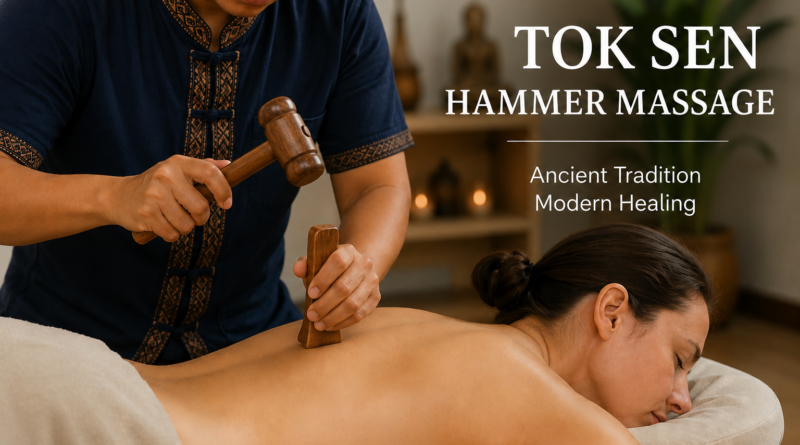
Tok Sen is one of the most unique and fascinating techniques within traditional Thai massage. Unlike most massage therapies that rely solely on the therapist’s hands, elbows, or forearms, Tok Sen uses specially crafted wooden tools—a wooden mallet and a wedge—to create rhythmic vibrations that travel deep into muscles and connective tissues.
At first glance, the idea of receiving a massage with a wooden hammer may seem unusual. However, when performed correctly by a trained therapist, Tok Sen is often experienced as both relaxing and remarkably effective.
The word “Tok” means to tap or to strike, while “Sen” refers to the body’s energy pathways, known as Sen Sib, which are fundamental to Traditional Thai Medicine. Together, Tok Sen can be translated as “tapping along the energy lines.”
The History of Tok Sen
Tok Sen originated in the ancient Lanna Kingdom of Northern Thailand, particularly in the regions around Chiang Mai and Lamphun. For centuries, the technique was passed down from master to student, often within the same family, making it one of Thailand’s most closely guarded traditional healing arts.
Because the knowledge was transmitted orally rather than through written documentation, different regions developed their own styles and methods. Despite these variations, the fundamental principle has always remained the same: using controlled rhythmic vibrations to restore balance and release tension throughout the body.
For many years, Tok Sen was virtually unknown outside Northern Thailand. Only during the past few decades has it gained international recognition through Thai massage schools, experienced teachers, and the growing worldwide interest in Traditional Thai Massage.
Today, some practitioners continue to teach Tok Sen according to traditional Lanna principles, while others combine it with modern anatomical knowledge, myofascial techniques, and evidence-based manual therapy.
How Does a Tok Sen Treatment Work?
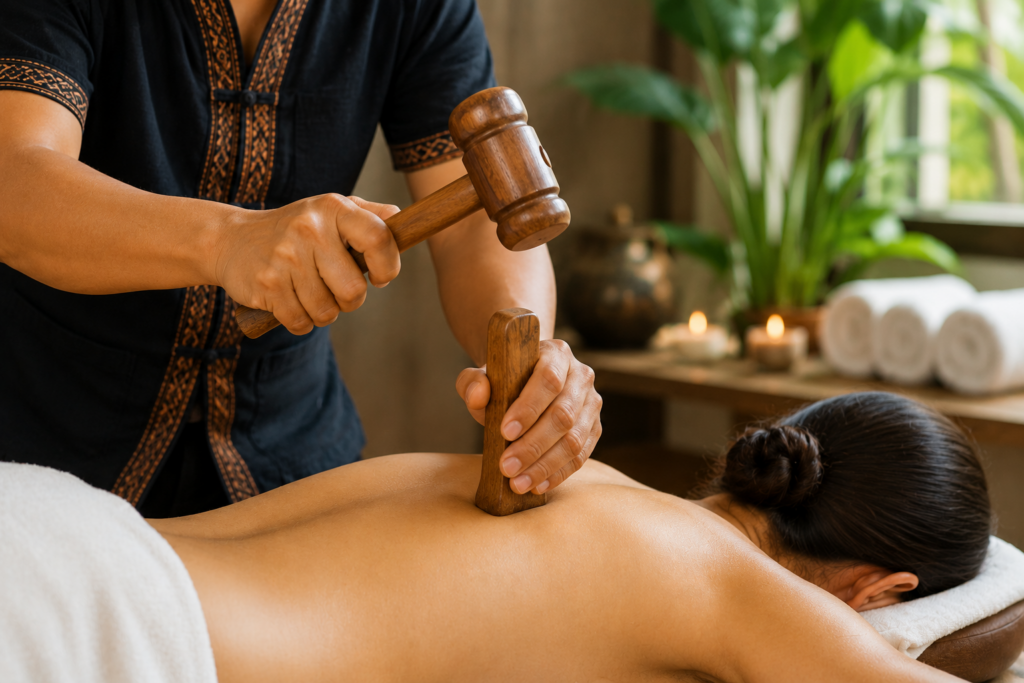
A Tok Sen treatment is performed using two specially designed wooden instruments: a wooden wedge and a small wooden mallet, traditionally handcrafted from hardwood such as tamarind.
The therapist places the wedge on the client’s body and gently strikes it with the mallet, creating rhythmic mechanical vibrations that travel through muscles, fascia, and surrounding soft tissues.
Rather than relying on heavy pressure, Tok Sen uses vibration to influence deeper structures, often allowing therapists to treat areas that may be difficult to access with conventional massage techniques.
Tok Sen is frequently combined with other treatment methods, including:
- Traditional Thai Massage
- Trigger Point Therapy
- Stretching techniques
- Myofascial Release
- Acupressure
- Clinical Massage
For this reason, Tok Sen is often integrated into a comprehensive treatment rather than being used as a standalone therapy.
What Happens Inside the Body?
Traditional Thai Medicine explains Tok Sen through the stimulation of the body’s Sen energy lines. From a modern scientific perspective, however, some of its effects may be explained by mechanical vibration and manual therapy principles.
The rhythmic tapping may help to:
- Reduce muscular tension
- Improve local blood circulation
- Stimulate connective tissue and fascia
- Increase joint mobility
- Relieve muscular discomfort
- Promote relaxation of the nervous system
Although scientific research remains limited, early clinical studies suggest that Tok Sen may help reduce pain and muscle tightness in certain musculoskeletal conditions, particularly involving the neck and shoulder region. More high-quality research is still needed to fully understand its therapeutic effects.
Advantages of Tok Sen
Effective for Deep Muscle Tension
The mechanical vibrations can reach deeper muscular structures without requiring excessive manual pressure, making treatment both effective and comfortable for many clients.
Better Ergonomics for Therapists
One of Tok Sen’s greatest advantages is that it reduces the physical strain placed on the therapist’s hands, thumbs, wrists, and elbows. The wooden tools perform much of the mechanical work, helping practitioners protect their own bodies throughout long careers.
A Unique Client Experience
The combination of rhythmic tapping, vibration, and traditional craftsmanship creates a treatment unlike any other massage technique. Many clients describe Tok Sen as deeply relaxing and almost meditative.
Expands the Therapist’s Skill Set
Adding Tok Sen to an existing practice allows therapists to offer something distinctive while providing greater flexibility in treatment planning.
Limitations and Considerations
Like any therapeutic technique, Tok Sen is not suitable for every client or every clinical situation.
Proper Training Is Essential
Tok Sen requires professional instruction and supervised practice. Incorrect technique can reduce effectiveness or cause discomfort.
Not Every Client Enjoys the Sensation
Some individuals may find the rhythmic tapping or sound unfamiliar, especially during their first treatment. Proper explanation beforehand often helps clients feel more comfortable.
Limited Scientific Evidence
Compared with many established manual therapy techniques, Tok Sen has received relatively little scientific investigation. Much of its reputation continues to be based on traditional knowledge and extensive clinical experience rather than large-scale research studies.
Contraindications
Tok Sen should generally be avoided—or used only with appropriate professional assessment—in cases such as:
- Acute injuries
- Recent fractures
- Active infections
- Severe osteoporosis
- Acute inflammation
- Certain vascular disorders
As with all manual therapies, a thorough client assessment should always be performed before treatment begins.
Why Should Massage Therapists Learn Tok Sen?
The massage profession continues to evolve, and clients increasingly seek therapies that combine tradition with innovation.
Learning Tok Sen offers several professional advantages:
- Expands your treatment options
- Differentiates your practice from competitors
- Provides an additional specialty skill
- Improves therapist ergonomics
- Integrates easily with many existing massage techniques
- Offers clients a unique and memorable therapeutic experience
For therapists seeking continuous professional development, Tok Sen represents both a valuable practical skill and a fascinating cultural tradition.
The Future of Tok Sen
Interest in Tok Sen continues to grow worldwide. More massage schools are introducing certified Tok Sen courses, and an increasing number of therapists are incorporating the technique into clinical practice, wellness centres, and spas.
At the same time, researchers are beginning to investigate how vibration-based manual therapies influence muscles, fascia, pain perception, and the nervous system. As scientific evidence develops, Tok Sen may become an even more widely recognised complementary treatment within modern manual therapy.
Conclusion
Tok Sen beautifully combines centuries-old Thai healing traditions with modern therapeutic practice. Using handcrafted wooden tools to generate controlled vibrations, it offers a distinctive approach to reducing muscular tension, improving mobility, and enhancing relaxation.
For professional massage therapists, Tok Sen is more than simply learning another technique—it is an opportunity to expand clinical skills, reduce physical strain, and offer clients a truly unique treatment experience. While scientific research is still emerging, both traditional wisdom and growing clinical interest suggest that Tok Sen has an important place in the future of professional massage therapy.

Please follow the IMA Social Medias and find ongoing Inspiration: Facebook, Instagram, Youtube, TikTok, Telegram Channel, Whatsapp Channel, Threads, X, Linkedin
At the International Massage Association we are ongoing try to elevate the Massage Profession via our many Articles, Podcasts, Masterclasses and via the Educational Conference at the World Championship in Massage.