
“Being a Massage Judge”
Article By IMA Hall of Fame member Anna Baroni
Dear fellow therapists,
I was offered this role seven years ago, when I first started attending the World Massage Championship—an event I hadn’t even known existed until then. Before becoming a judge, I participated as a competitor; I chose Copenhagen, where I became known for my exclusive massage techniques.
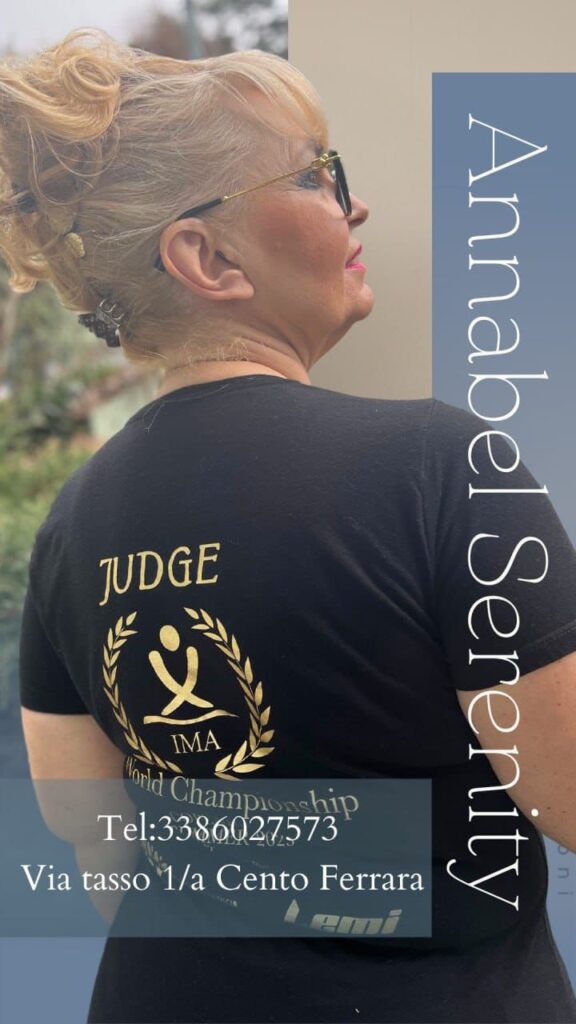
In 2019, many renowned masters of the time took part, and the panel of judges was formed. Subsequently, I was invited to judge in Romania, Switzerland, Poland, Greece, Bulgaria, and Tokyo—the latter being the most impressive experience, with 3,000 participants. I was selected thanks to my reputation and experience as an Italian instructor. I went on to receive five awards, was inducted into the IMA Hall of Fame, and shortly thereafter, became an IMA judge.
To me, being a judge means, first and foremost, accepting responsibility. When observing a competitor and being called upon to provide an evaluation, you are not simply assigning a score; you are acknowledging a person’s work, dedication, and journey. Behind every performance lie training, sacrifices, emotions, and expectations. That is why the role of a judge demands expertise, attentiveness, and deep respect.
A judge must be impartial, setting aside personal preferences, expectations, the competitor’s reputation, and any factors unrelated to the performance itself. Fairness stems from the ability to observe objectively and apply the same criteria to everyone.
However, impartiality alone is not enough; preparation and keen observational skills are essential. A good judge knows how to recognize what works—identifying whether a technique is based on a genuine method rather than improvisation—as well as the progress and qualities that make each competitor unique. Above all, a judge looks for something original and innovative—something never seen before. It is not a matter of simply copying and pasting what is done in major championships.
When I watch a competitor, I look for focus, control, technique, precision, and fluidity. I observe their listening skills and the quality of their execution, as well as their ability to handle challenges and react to unexpected situations.
Key values include the competitor’s talent and the mindset they bring to the client and the competition itself. A judge must remember that every score carries weight and must have the courage to be honest.
I also look for balance and composure. A judge must maintain the clarity of mind needed to compare what they see against the criteria established in the championship rules. It is this ability to remain balanced that gives the competition credibility.
Finally, I believe that being a judge also entails an educational role. An evaluation can become a tool for growth when it is grounded in expertise and delivered with respect. Every competitor should leave the competition with advice on where to improve—whether in posture, fluidity, technique, client interaction, or innovation (an element often lacking).
Ultimately, for me, being a judge means being knowledgeable without arrogance, strict without being unfair, and impartial without being distant. A competition is not just about numbers and rankings; it is about people who have chosen to put themselves to the test, challenge themselves to improve, and share their experiences. The judge’s task is to contribute—with professionalism and integrity—to making the contest as fair as possible, and to convey the positive energy that serves as essential fuel for a massage therapist.
I love my job, and I am one of them, with 42 years of experience. Humility is my strength.
Participating in the Copenhagen championship represents a significant opportunity for professional growth.”
Anna Baroni, 2026.
Did you like the article? Or did you like taking part of the World Championship in Massage or one of our classes, then please feel free to give us a nice review on Google.

Watch Anna baroni in the Below video